
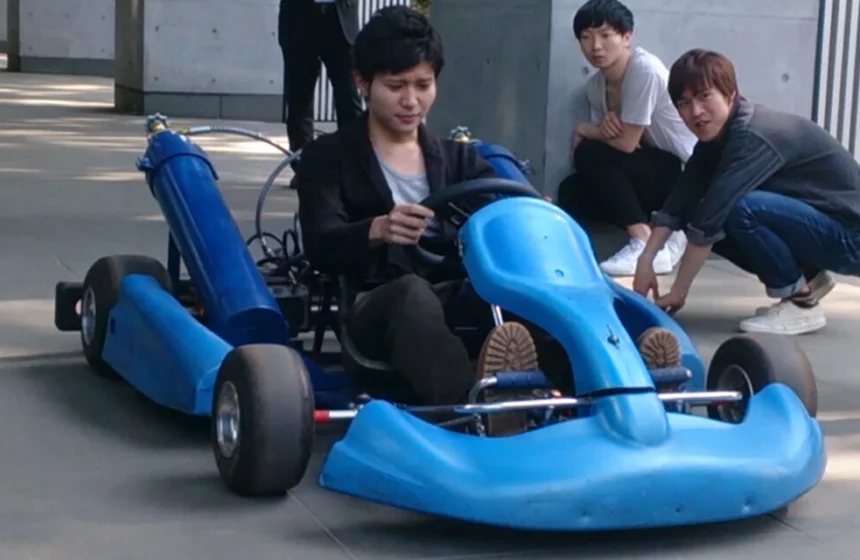
A story about proving 20 years of fundamental research with a running go-kart.
Overview
| Client | Waseda University (Joint research with the Faculty of Science and Engineering and Onoda Laboratory) |
| Project Type | Basic Research + Practical Demonstration |
| Period | Total 20 years (including basic theory stage) |
| Value Provided | Demonstrating the application potential of a fully rotary balanced cylinder device as an air engine |
| deliverable | Mountable go-kart, multiple patents, numerous academic presentations |
Project Background
“If we apply the inner cycloid curve, we can convert the reciprocating motion of the piston into rotation… That’s the theory, but does it really move?”
This was a question the representative had faced even before the company was founded.
Reciprocating engines generate power by moving the piston up and down.
However, vibration and mechanical losses were woven into the very process of “up-down → rotation” transformation.
Twenty years ago, we arrived at the theory that applying the inner cycloid curve could convert round-trip and rotational cycles with almost zero mechanical losses.
However, we cannot simply leave it within a paper.
“Only by moving it can you reach the way of life of the future.”
With that in mind, we teamed up with Waseda University and embarked on a hands-on demonstration.
What we worked on
Phase 1. Basic Theory and Model Prototype (2005–2010)
We rebuilt the model to reproduce the internal cycloid mechanism three times.
The first time, the friction was greater than expected; the second, the balance adjustment was insufficient; and on the third, ‘uniform rotation’ was achieved.
At this point, he filed his first Japanese patent application.
Phase 2. Actual engine deployment (2011–2018)
Through joint research with the Onoda Laboratory at Waseda University, this mechanism was commercialized as a compressed air-driven air engine.
After several prototypes, it was installed in a go-kart that can be driven.
We also proceeded with patent applications in Japan, the United States, and Europe in parallel.
Phase 3. Expansion of application areas (2019–present)
Applications beyond air engines: oxygen concentrators, dental compressors, air conditioning and refrigeration compressors, various pumps
Results
- Patents Obtained: Multiple Obtained in Japan, the United States, and Europe
- Academic Presentations: Multiple reports at the Japan Society of Mechanical Engineers, the Society of Automotive Engineers, etc.
- Awards: Includes awards for power technology
- Actual vehicle: Go-kart equipped with an air engine (driving proven and tested)
- Derivative applications: Testing for medical devices, air conditioning equipment, and various pumps
Voices of Collaborators
Standard mechanical engineering textbooks state, ‘The conversion between reciprocating and rotational motion always involves a loss in crank characteristics.’
The joint research with Airsurf was a process that questioned that assumption.
Twenty years was by no means short, but the patented theory and the fact of a go-kart in action—this pair could be the basis for rewriting textbooks. And above all, if this technology eventually makes its way into medical devices and home appliances, reaching the point where it quietly supports someone’s life, that is the true purpose of research. ── Collaborators and university faculty (summarized with permission)
What I learned
Basic research on power technology cannot be completed in just five or ten years. Twenty years is the time when a child born now grows up.
The skills honed over time will continue to work at the bottom of life for 50 or 100 years.
This is not a job that provides answers in a short period. However, it is a long-lasting task—we gained that assurance through this project.